

Where to Buy API 13A Barite and API Class G Cement in Iraq and the GCC
Drilling contractors in Iraq and the GCC can source API 13A barite and API Class G well cement directly from specialized B2B exporters like Raiva International Trading Group. This guide covers regional distributor networks, logistics, and technical specifications to help you secure reliable, certified materials for your operations.
Regional Distributor Networks
Procurement in the Middle East often relies on a mix of local distributors and direct exporters. For drilling contractors, the distinction between a local stockist and a direct source is critical for lead times and technical support. Raiva International Trading Group operates as a direct exporter, eliminating intermediaries by supplying from certified quarries and mines in Iran and Oman. This structural advantage allows for better FOB and CIF pricing and more direct communication regarding technical requirements.
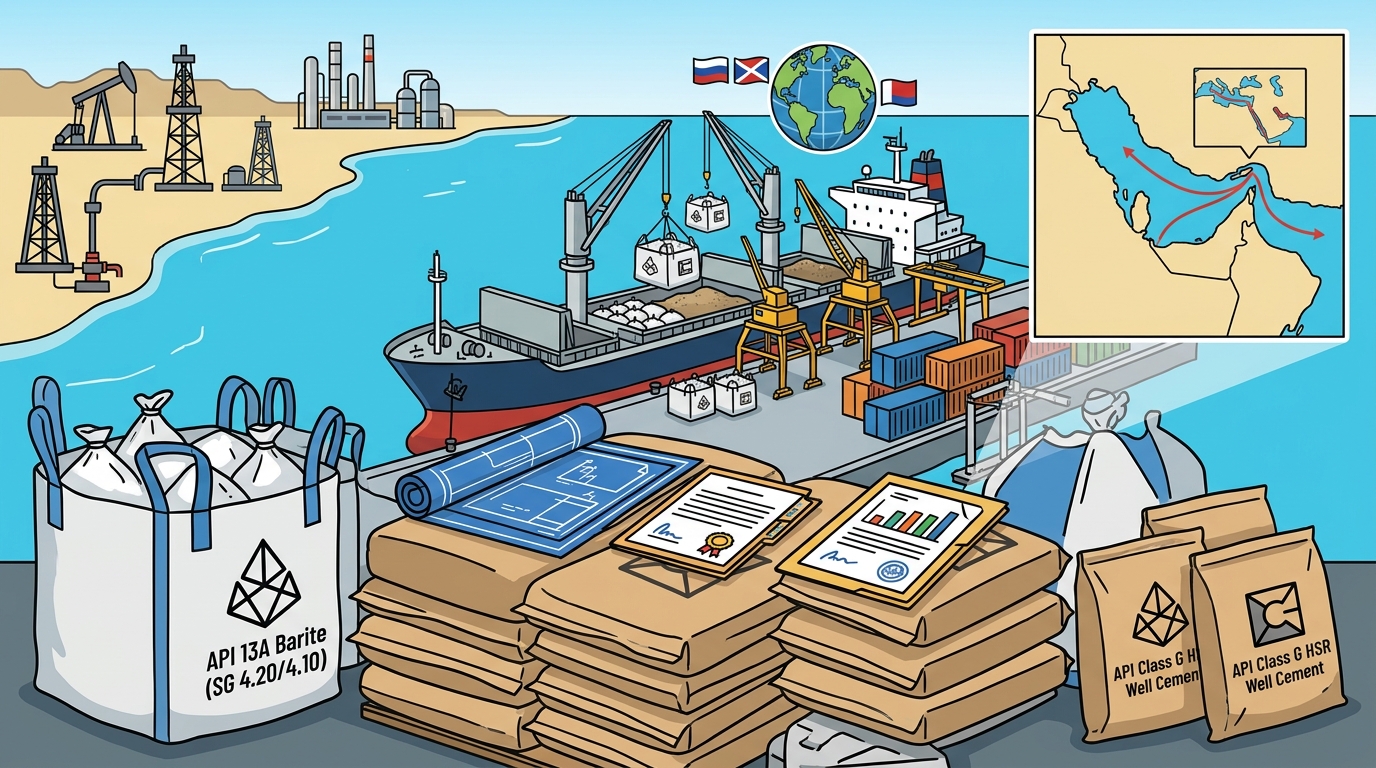
The regional network for drilling fluids is concentrated around key ports and industrial hubs. In the GCC, Muscat in Oman serves as a major logistics hub for the region, while Bandar Abbas in Iran handles significant bulk cargo exports. Contractors in Iraq often source materials through these ports, utilizing established trade routes to move bulk minerals into the country. By working with a supplier that has trade desks in both Muscat and Yazd, you gain access to a coordinated network that can manage cross-border logistics efficiently.
Direct Export vs. Local Stock
Local stockists offer immediate availability but may lack the technical depth to provide batch-specific certificates. Direct exporters, such as Raivaco, provide a direct line to the production source. This is particularly important for API 13A barite, where particle size distribution and specific gravity must be tightly controlled. A direct relationship ensures that any deviations in the material are caught at the source rather than at the rig site.
API 13A Barite Specifications
API 13A barite is the standard weighting agent for water-based drilling fluids. The primary metric for this material is specific gravity, which determines the mud weight it can achieve. Raivaco supplies API 13A drilling barite at specific gravity 4.20 and 4.10. The 4.20 grade is the most common for deep and directional drilling, providing the necessary density to control formation pressures.
Beyond specific gravity, the particle size distribution (PSD) is the defining characteristic of API 13A barite. The standard requires that the residue on a 200-mesh sieve (75 microns) be below 3.0 wt%. This ensures that the particles are fine enough to remain in suspension and not settle out of the fluid column. Additionally, the percentage of particles finer than 6 microns is capped at 30 wt% to prevent excessive plastic viscosity, which can make the mud difficult to pump.
Key Technical Parameters
When evaluating barite for your operations, focus on the following parameters. The pH before and after heating at 180°F must be above 6.5 to ensure chemical stability. Apparent viscosity, both before and after gypsum addition, must not exceed 125 cP. These values indicate whether the barite will flocculate the mud when it encounters anhydrite downhole. Raivaco’s API 13A barite is tested to these standards, with a typical density of 4.21 g/cm³ and a 200-mesh residue of 2.04%.
API Class G Well Cement
API Class G well cement is the primary material used for primary cementing in oil and gas wells. It is a high sulfate-resistant (HSR) cement designed to provide a durable barrier between the casing and the formation. Raivaco supplies API Class G HSR well cement tested to API Spec 10A-2019. This grade is characterized by a low C3A content, typically held to 1.90%, which provides resistance to sulfate attack in the formation.
The performance of Class G cement is defined by its thickening time and compressive strength. At 60°C, the thickening time is typically around 105 minutes, and the 8-hour compressive strength reaches approximately 1945 psi. These values are critical for ensuring that the cement sets at the correct rate and develops sufficient strength to isolate the wellbore. The low C3A content also contributes to the cement’s resistance to corrosion, which is essential for long-term well integrity.
Comparison of Cement Grades
| Property | API Class G HSR | Portland Type I-425 |
|---|---|---|
| Standard | API Spec 10A-2019 | ISIRI 389 |
| C3A Content | 1.90% | 7.2% |
| Sulfate Resistance | High (HSR) | Normal |
| 28-Day Strength | Per API 10A | 440 kg/cm² |
| Typical Use | Oil & Gas Well Cementing | Structural Concrete |
Logistics and Supply Chain
The logistics of moving bulk minerals and chemicals from the source to the rig site is a complex operation. Raivaco ships from the ports of Bandar Abbas and Bandar Imam Khomeini in Iran, as well as from Muscat in Oman. The choice of port depends on the destination and the specific Incoterms agreed upon in the contract. For buyers in Iraq and the GCC, FOB and CIF terms are the most common, with CIF providing a more predictable landed cost.
Lead times for standard grades are typically 7 to 14 days. This includes the time required for production, testing, and loading. For bulk vessel shipments, the minimum order quantity is 500 MT, while bagged shipments have a minimum of 25 MT. The packaging options include bulk vessel, jumbo bags, and 50 kg sacks, allowing for flexibility in how the material is received and stored at the site.
Incoterms and Loading Ports
Understanding Incoterms is essential for managing risk and cost in international trade. EXW (Ex Works) places the responsibility on the buyer to arrange all transportation and insurance. FOB (Free On Board) means the seller is responsible for the goods until they are loaded onto the vessel. CIF (Cost, Insurance, and Freight) includes the cost of the goods, insurance, and freight to the destination port. Raivaco offers all three terms, allowing buyers to choose the arrangement that best fits their operational needs.
Quality Assurance and Certification
Quality assurance is the foundation of any reliable supply chain for drilling materials. Every shipment from Raivaco includes a batch-specific Certificate of Analysis (CoA) or mill certificate. This document provides the actual test results for the specific batch being shipped, rather than a generic specification. For barite, the CoA includes density, pH, viscosity, and particle size distribution. For cement, it includes chemical analysis, setting time, and compressive strength.
The testing is performed by an ISO/IEC 17025 accredited laboratory, ensuring that the results are accurate and reliable. This level of certification is critical for drilling contractors, as it provides the documentation needed to meet regulatory requirements and internal quality standards. By working with a supplier that provides this level of transparency, you can be confident that the materials you receive meet the specifications required for your operations.
Key Takeaways
- Direct exporters like Raivaco offer better pricing and technical support than local stockists.
- API 13A barite must have a specific gravity of at least 4.20 and a 200-mesh residue below 3.0%.
- API Class G HSR cement is defined by its low C3A content (1.90%) and high sulfate resistance.
- Lead times for standard grades are typically 7 to 14 days, with bulk shipments requiring a 500 MT minimum.
- Every shipment includes a batch-specific Certificate of Analysis from an ISO/IEC 17025 accredited lab.
- Logistics are managed from Bandar Abbas, Bandar Imam Khomeini, and Muscat, with FOB, CFR, and CIF terms available.
Frequently Asked Questions
What is the minimum order quantity for API 13A barite?
The minimum order quantity for bagged API 13A barite is 25 MT, which fits in one 20-foot container. For bulk vessel shipments, the minimum is 500 MT.
What is the difference between API 13A barite and white barite powder?
API 13A barite is a drilling-grade material with a specific gravity of 4.20 or 4.10, designed for weighting drilling fluids. White barite powder is a chemical-grade material with 95% BaSO4, used as a filler in paints, plastics, and rubber.
How is API Class G cement different from Portland cement?
API Class G cement is a high sulfate-resistant cement with a low C3A content (1.90%), designed for oil and gas well cementing. Portland cement is a general-purpose cement with a higher C3A content (7.2%), used for structural concrete and construction.
What are the typical lead times for barite and cement shipments?
Standard lead times for both barite and cement are 7 to 14 days. This includes production, testing, and loading. Custom grades or large bulk shipments may require longer lead times.
What documents are provided with each shipment?
Every shipment includes a batch-specific Certificate of Analysis (CoA) or mill certificate. This document provides the actual test results for the specific batch, including chemical analysis and physical properties.
Can Raivaco ship to Iraq?
Yes, Raivaco ships to Iraq and other countries in the GCC. The logistics are managed from Bandar Abbas and Muscat, with FOB and CIF terms available. Specific shipping arrangements can be discussed with the trade desk.
Conclusion
Sourcing API 13A barite and API Class G well cement in Iraq and the GCC requires a partner that combines technical expertise with reliable logistics. Raiva International Trading Group provides direct access to certified sources, ensuring that you receive materials that meet the strictest standards. By working with a direct exporter, you can secure better pricing, faster lead times, and the technical support needed to keep your operations running smoothly. To plan your next procurement, request a quote from our trade desk.