
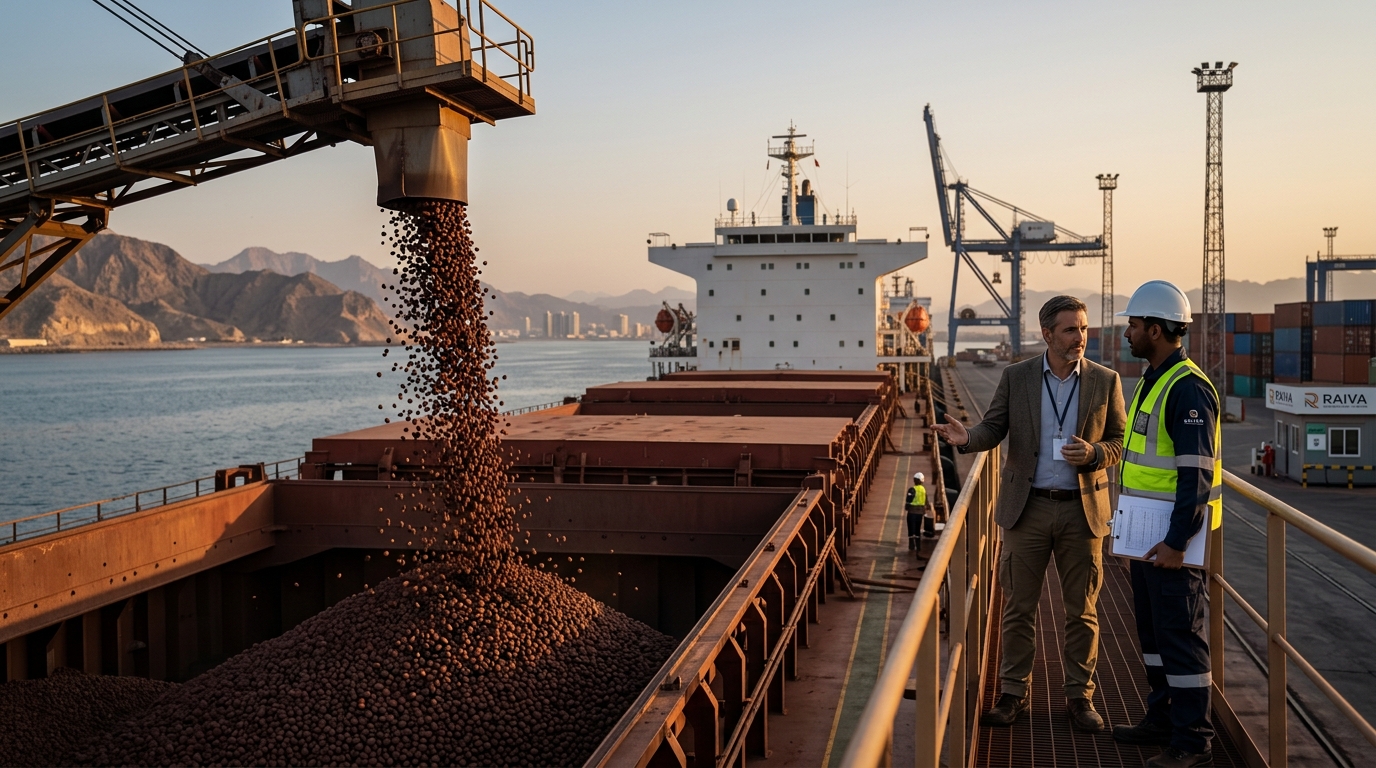
Iron Ore Pellets and Concentrate Exporters for GCC and China Steel Mills
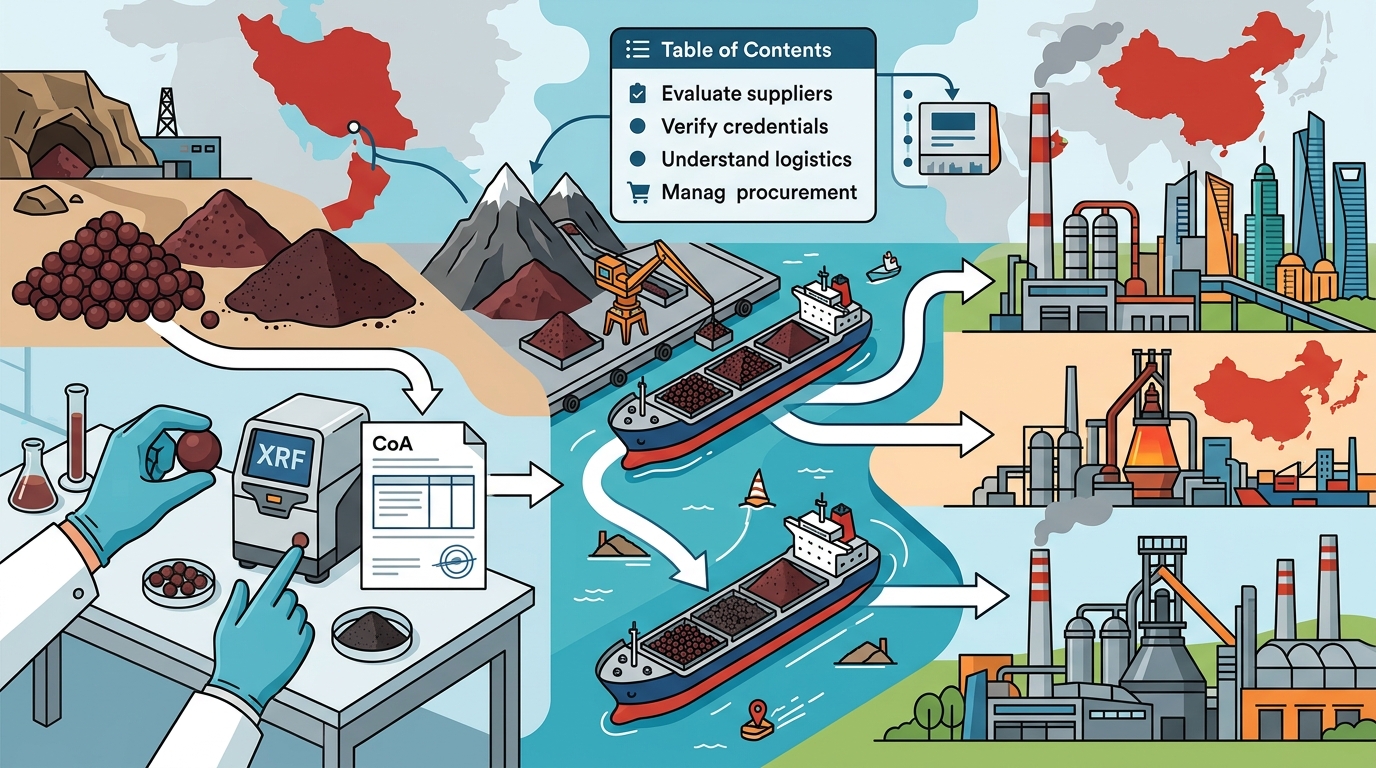
Steel mills in Oman, China, and the GCC require iron ore pellets and concentrate that meet strict chemical and physical specifications. Raiva International Trading Group (RAIVACO) is a specialized B2B exporter that supplies these materials directly from certified sources in Iran and Oman. This guide covers how to evaluate suppliers, verify credentials, understand logistics, and manage the procurement process for bulk iron ore shipments.
How to Choose a Reliable Supplier
Choosing the right supplier for iron ore pellets and concentrate requires looking beyond the initial price quote. A reliable supplier is one that provides transparent, batch-specific quality data and has direct access to the source material. Raiva International Trading Group operates as a specialized trading house focused entirely on minerals and chemical products. By combining owned mining assets with a vetted network of regional producers, we eliminate intermediaries. This structural advantage guarantees consistent quality, aggressive pricing, and reliable supply for our B2B partners.
Direct Source Access
Direct source access is the primary differentiator in the iron ore market. When a supplier has direct relationships with mines, they can control the quality of the raw material before it is processed into pellets or concentrate. This reduces the risk of contamination or inconsistent grading that often occurs when multiple middlemen handle the cargo.
Quality Testing Standards
Every batch of iron ore we supply is quality-tested to international trading standards. We issue a Certificate of Analysis (CoA) for every shipment, which details the chemical composition and physical properties of the specific lot. This ensures that the material arriving at your mill matches the specification agreed upon in the contract.
Specific Questions to Ask Before Committing
Before signing a contract, procurement teams should ask specific technical and logistical questions. These questions help verify the supplier's capability and ensure the material will perform in your blast furnace or direct reduction process.
Chemical Composition and Purity
Ask for the exact percentage of total iron (Fe), ferrous iron (FeO), and gangue elements like silica (SiO2) and alumina (Al2O3). For magnetite-based ores, the ferrous iron content is a critical identifier. For example, our iron ore is certified at Fe(T) 50±1% with ferrous iron above 14%, which identifies it as magnetite rather than haematite.
Physical Properties and Sizing
Inquire about the particle size distribution and moisture content. For blast furnace feed, the sizing must be consistent to ensure proper burden distribution. Our standard iron ore is screened to 0-10 mm with 0% moisture, which is ideal for sintering and pelletizing operations.
Logistics and Incoterms
Clarify the available Incoterms. We offer EXW, FOB, CFR, and CIF terms. Understanding the difference between FOB (Free On Board) and CIF (Cost, Insurance, and Freight) is crucial for budgeting and risk management. FOB transfers risk to the buyer once the cargo is on the vessel, while CIF includes insurance and freight to the destination port.
Verifying Claims and Credentials
Verification is a critical step in the procurement process. You must ensure that the supplier's claims about quality and logistics are backed by independent evidence.
Certificate of Analysis (CoA)
A CoA is a document issued by the supplier or an independent laboratory that details the chemical and physical properties of a specific batch. It is not a generic specification sheet; it is a report for the exact cargo being shipped. Always request a CoA for the specific lot number before shipment.
Third-Party Inspection
For high-value shipments, consider hiring a third-party inspection agency such as SGS or Bureau Veritas. These agencies can verify the weight, quality, and loading condition of the cargo at the port of origin. This adds an extra layer of protection and ensures that the cargo matches the CoA.
The Export Process and Timeline
Understanding the export process helps you plan your inventory and production schedules. The process typically involves several stages, from initial inquiry to final delivery.
Inquiry and Quotation
The process begins with an inquiry where you specify the required grade, quantity, and destination port. Our trade desk responds within 24 hours with a detailed quotation, including pricing, Incoterms, and lead time.
Contract and Payment
Once the terms are agreed upon, a sales contract is signed. Payment is typically made via Letter of Credit (L/C) or Telegraphic Transfer (T/T). The contract specifies the binding quality parameters and the penalty clauses for any deviations.
Production and Loading
The supplier arranges for the material to be processed, screened, and loaded onto the vessel. For bulk shipments, this is done at deep-water ports like Bandar Abbas or Bandar Imam Khomeini. The loading process is supervised to ensure the correct quantity is loaded.
Shipping and Delivery
The vessel departs for the destination port. Transit times vary depending on the route. For example, shipments to Oman may take a few days, while shipments to China may take several weeks. Upon arrival, the cargo is discharged and inspected.
Factors That Drive Pricing
The price of iron ore is influenced by several factors, including global market trends, logistics costs, and specific quality parameters.
Global Market Trends
Iron ore prices are volatile and are influenced by global demand, particularly from China. Market indices such as the Platts index provide a benchmark for pricing. However, the final price for a specific cargo will also depend on the quality of the ore.
Logistics and Freight
Freight costs are a significant component of the total landed cost. These costs are influenced by fuel prices, vessel availability, and route congestion. For example, shipping from the Persian Gulf to China involves a longer transit time and higher freight costs than shipping to Oman.
Quality Premiums
Ores with higher iron content and lower gangue levels command a premium. Conversely, ores with higher phosphorus or sulfur levels may be discounted. The specific quality of the ore is a major driver of the final price.
Common Mistakes and How to Avoid Them
Procurement teams often make mistakes that can lead to costly delays or quality issues. Being aware of these common pitfalls can help you avoid them.
Ignoring the CoA
One of the most common mistakes is accepting a generic specification sheet instead of a batch-specific CoA. Always insist on a CoA for the exact lot being shipped. This ensures that you are getting the quality you paid for.
Underestimating Logistics
Another mistake is underestimating the complexity of logistics. Shipping bulk minerals involves coordinating with multiple parties, including the supplier, freight forwarder, and port authorities. Delays in any of these stages can impact your production schedule.
Not Verifying the Supplier
Finally, not verifying the supplier's credentials can lead to dealing with a middleman who does not have direct access to the source. This can result in inconsistent quality and higher prices. Always verify the supplier's direct relationships with mines and factories.
Direct Exporters Versus Intermediaries
When sourcing iron ore, you have two main options: direct exporters and intermediaries. Each has its own advantages and disadvantages.
| Feature | Direct Exporter (e.g., Raivaco) | Intermediary |
|---|---|---|
| Price | Competitive, no middleman margin | Higher, includes margin |
| Quality Control | Direct access to source, consistent quality | Variable, depends on upstream supplier |
| Transparency | High, direct communication with source | Lower, multiple layers of communication |
| Logistics | Streamlined, direct shipping | Complex, multiple handoffs |
Direct exporters like Raiva International Trading Group offer a more transparent and cost-effective solution. By eliminating intermediaries, we can provide better pricing and more consistent quality.
Sourcing for Specific Mill Requirements
Different steel mills have different requirements for their iron ore feed. Understanding these specific needs is crucial for selecting the right supplier.
Blast Furnace Mills
Blast furnace mills require a consistent supply of iron ore pellets and concentrate. The ore must have a high iron content and low gangue levels to ensure efficient hot metal production. Our iron ore is screened to 0-10 mm, which is ideal for sintering and pelletizing.
Direct Reduction Mills
Direct reduction mills require low-gangue ore to keep the reformer efficient. Our iron ore has silica under 8% and alumina under 2%, which makes it suitable for DRI and HBI feed.
Pelletizing Plants
Pelletizing plants require a concentrate feed that can be easily pelletized. Our iron ore pellets are supplied in bulk with a Certificate of Analysis issued per shipment, ensuring consistent quality for the pelletizing process.
Trade Rules and Buyer Protections
International trade is governed by a set of rules and regulations that protect both buyers and sellers. Understanding these rules is essential for a smooth transaction.
Incoterms 2020
Incoterms are a set of international trade terms published by the International Chamber of Commerce (ICC). They define the responsibilities of buyers and sellers in the delivery of goods. We work to EXW, FOB, CFR, and CIF terms under Incoterms 2020.
Contractual Protections
A well-drafted sales contract provides legal protection for both parties. It should clearly specify the quality parameters, payment terms, delivery schedule, and penalty clauses for any deviations. Always have your contract reviewed by a legal professional.
Regional Logistics for Oman and the GCC
Shipping to Oman and the GCC involves specific logistical considerations that differ from other regions.
Port Infrastructure
Ports in Oman and the GCC are well-equipped to handle bulk cargo. They have modern unloading facilities and efficient customs processes. This makes them ideal destinations for iron ore shipments.
Transit Times
Transit times from Iran to Oman are relatively short, often just a few days. This makes it an attractive option for mills in the region that require a reliable and quick supply of iron ore.
Procurement Timing and Market Cycles
Timing is a critical factor in iron ore procurement. The market is cyclical, and prices fluctuate based on supply and demand.
Seasonal Demand
Demand for iron ore is often seasonal, with peaks during certain months of the year. Planning your procurement in advance can help you secure better pricing and ensure a steady supply.
Market Volatility
Iron ore prices are volatile and can change rapidly. Monitoring market trends and adjusting your procurement strategy accordingly can help you manage risk and optimize costs.
Long-Term Supply Reliability
Building a long-term relationship with a reliable supplier is the best way to ensure a steady supply of iron ore. Raiva International Trading Group is committed to providing consistent quality and reliable supply to our B2B partners.
Consistent Quality
By working directly with certified sources, we can ensure that the quality of our iron ore is consistent from batch to batch. This reduces the risk of production disruptions and ensures that your mill operates at peak efficiency.
Reliable Supply
We have a robust logistics network that allows us to deliver cargo on schedule. Our two regional trade desks, coordinated across time zones, ensure that we can respond quickly to any issues that may arise during the shipping process.
Key Takeaways
- Choose a supplier with direct access to the source material to ensure consistent quality.
- Always request a batch-specific Certificate of Analysis (CoA) for every shipment.
- Understand the difference between FOB and CIF terms to manage risk and budget effectively.
- Verify the supplier's credentials and consider third-party inspection for high-value shipments.
- Direct exporters offer better pricing and transparency compared to intermediaries.
- Plan your procurement in advance to manage market volatility and ensure a steady supply.
- Build a long-term relationship with a reliable supplier to ensure consistent quality and delivery.
Frequently Asked Questions
What is the minimum order quantity for iron ore?
The minimum order quantity for bagged iron ore is 1 x 20 ft container (approx. 25 MT). For bulk vessel shipments, the minimum is 500 MT.
What Incoterms do you offer?
We offer EXW, FOB, CFR, and CIF terms under Incoterms 2020. Standard loading is at Bandar Abbas and Bandar Imam Khomeini.
Do you provide a Certificate of Analysis?
Yes, a batch-specific Certificate of Analysis is issued with every shipment. This document details the chemical and physical properties of the specific lot.
What is the lead time for standard grades?
The lead time for standard grades is 7-14 days. This can vary depending on the specific requirements and logistics.
Can you supply custom grades?
Yes, we can produce custom grades to your exact specification. If none of our standard grades matches your target chemistry, fineness, or packaging, send us your requirements.
How do I request a quote?
You can request a quote by visiting our Get a Quote page. Our trade desk will respond within 24 hours.
Conclusion
Selecting the right supplier for iron ore pellets and concentrate is a critical decision for steel mills in Oman, China, and the GCC. By choosing a direct exporter like Raiva International Trading Group, you can benefit from competitive pricing, consistent quality, and reliable supply. We are committed to providing our B2B partners with the highest quality minerals and chemical products, shipped directly from certified sources. To plan your next shipment, for a detailed quotation.