
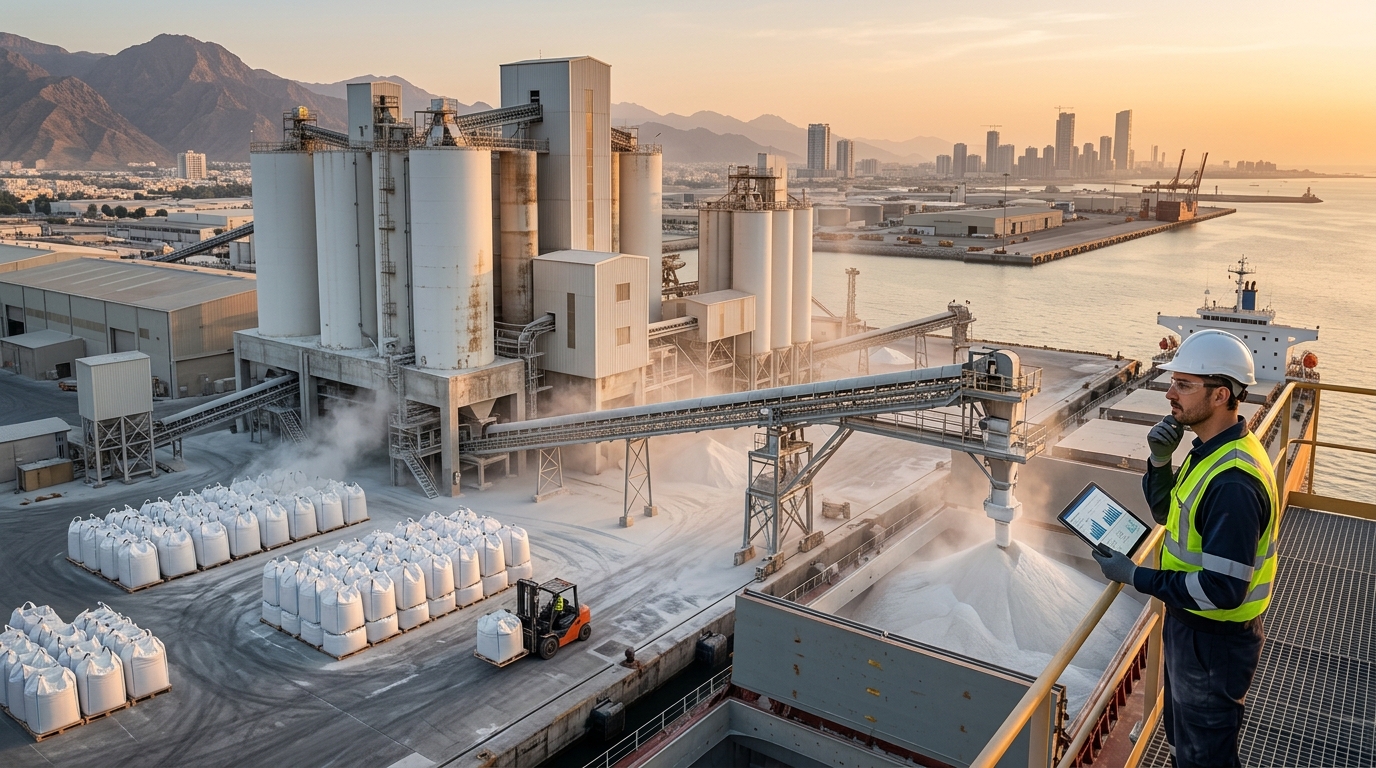
Bulk Quicklime and Hydrated Lime for GCC Steel and Water Treatment
Procurement teams in the Gulf Cooperation Council (GCC) can source bulk quicklime and hydrated lime directly from specialized B2B exporters like Raiva International Trading Group (RAIVACO). This guide covers how to evaluate regional suppliers, select the correct chemical grade for steelmaking or water treatment, and navigate bulk delivery formats. It provides a practical framework for qualifying vendors, verifying batch certificates, and structuring logistics for high-volume industrial applications.
GCC Lime Suppliers and Sourcing Strategy
Quicklime is calcium oxide (CaO) produced by calcining limestone at high temperatures, while hydrated lime is calcium hydroxide (Ca(OH)2) created by adding water to quicklime. The distinction between these two products is critical for industrial buyers. Steelmaking operations typically require the high reactivity and heat generation of quicklime for slag formation. Water treatment utilities often prefer hydrated lime because it disperses directly into water without the need for on-site slaking equipment. Understanding this chemical difference is the first step in selecting the right supplier.
Direct Access to Resources
When evaluating suppliers in the GCC and the broader Middle East, direct access to mining assets is a primary differentiator. Raiva International Trading Group operates with a structural advantage by combining owned mining assets with a vetted network of regional producers. This model eliminates intermediaries, which often adds cost and reduces quality control. For buyers in the GCC, sourcing directly from a specialized trading house ensures that the material arrives with a batch-specific Certificate of Analysis (CoA). This document verifies the chemical composition, including CaO content and impurity levels, before the cargo leaves the port of origin.
Grade Selection for Industrial Applications
Steel mills and water utilities have distinct requirements for lime grades. Quicklime is available in various mesh sizes, such as Mesh 70 and Mesh 170. A high-reactivity milled grade, often referred to as Super-90, is preferred for processes requiring rapid slag formation. Hydrated lime is supplied in general, special, and economy grades. The special grade, often milled to Mesh 400, offers finer particle size for better dispersion in water treatment dosing systems. Buyers should specify reactivity alongside purity. A lime that meets a 90% CaO purity threshold but has low reactivity may fail in industrial applications. Standards such as EN 459-2 report reactivity as t60, the time a standard slaking test takes to reach 60 degrees Celsius. Specifying this metric ensures the product performs as expected in the plant.
Quality Assurance and Documentation
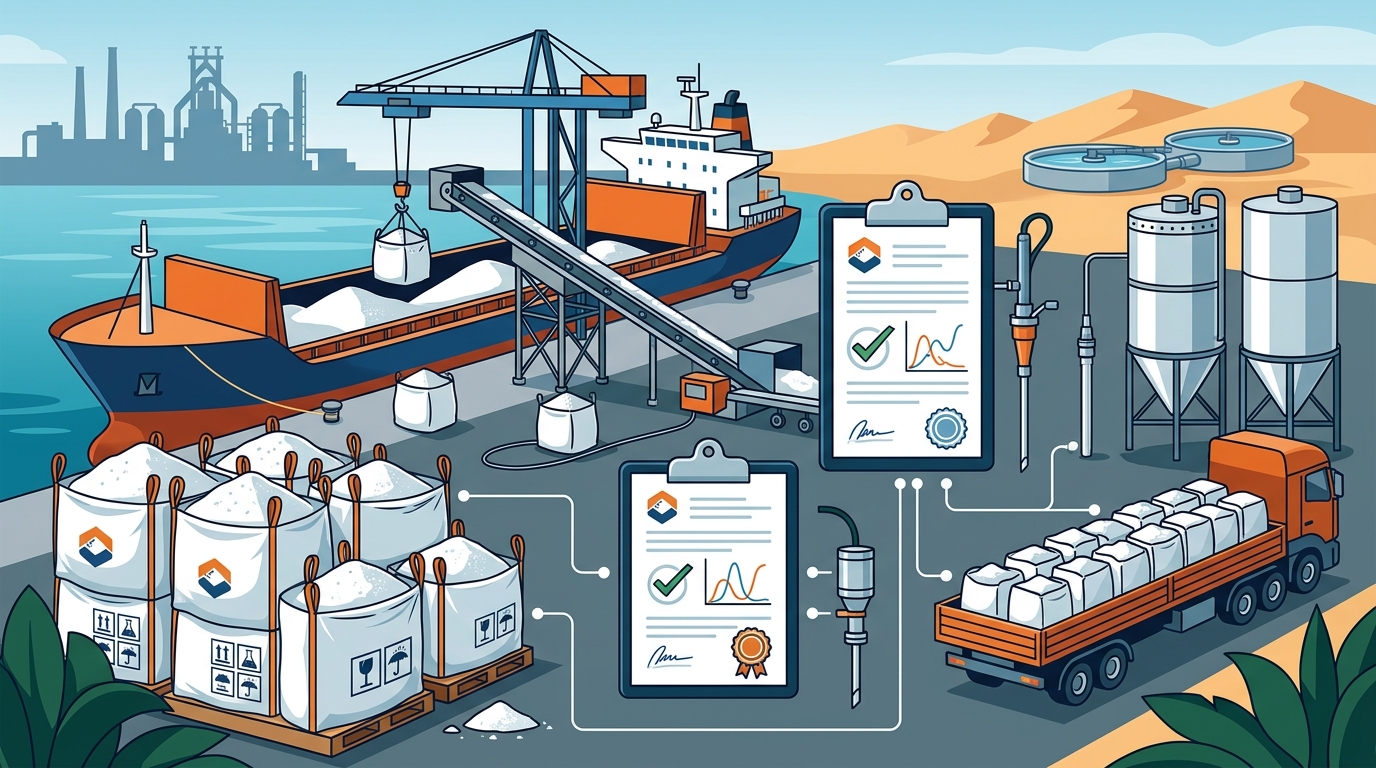
Reliable suppliers provide transparent documentation. Raiva International Trading Group publishes technical data sheets and XRF analyses on its product pages. Every shipment is accompanied by a batch-specific Certificate of Analysis. This practice allows procurement teams to verify that the delivered material matches the contracted specification. Third-party inspection by agencies such as SGS or Bureau Veritas is also available at the buyer's request. This level of documentation is essential for maintaining process consistency in steelmaking and water treatment. It provides a clear audit trail for quality control teams and helps resolve any discrepancies that may arise during loading or transit.
Bulk Delivery Formats and Logistics
Logistics play a decisive role in the total cost of ownership for bulk lime. The format in which the material is shipped affects handling, storage, and the final price per tonne. Raiva International Trading Group offers multiple delivery formats to accommodate different operational needs. These include bulk vessel shipments, jumbo bags, and standard 25 kg or 50 kg polypropylene bags. Each format has specific advantages depending on the buyer's infrastructure and volume requirements.
Incoterms and Port of Loading
Understanding Incoterms is crucial for structuring a bulk lime contract. Raiva International Trading Group ships under EXW, FOB, CFR, and CIF terms in accordance with Incoterms 2020. FOB (Free On Board) means the seller clears the goods for export and loads them onto the vessel at the port of loading. The buyer assumes all risk and cost from that point. CIF (Cost, Insurance, and Freight) includes the cost of the goods, insurance, and freight to the destination port. For GCC buyers, standard loading often occurs at Bandar Abbas or Bandar Imam Khomeini in Iran. Other ports can be arranged by agreement. The choice of Incoterm affects who arranges marine insurance and who is responsible for port handling fees. Buyers should align the chosen Incoterm with their internal logistics capabilities and risk management policies.
Packaging Options and Handling
Packaging determines how the lime is handled at the destination. Bulk vessel shipments are ideal for large-scale operations with dedicated unloading equipment. The minimum order quantity for bulk vessel shipments is typically 500 MT. For smaller volumes or sites without bulk unloading infrastructure, bagged options are more practical. Jumbo bags, ranging from 1 to 1.5 MT, are efficient for forklift handling and reduce the number of individual units to manage. Standard 25 kg or 50 kg bags are suitable for smaller plants or sites with manual handling. Moisture-proof PE lining is available on request for bagged shipments. This is particularly important for quicklime, which is hygroscopic and can react with moisture in the air. Proper packaging prevents clumping and ensures the material remains free-flowing upon arrival.
Lead Times and Scheduling
Lead times for standard lime grades are generally 7 to 14 days. This timeframe covers production, quality testing, and loading. Buyers should account for additional transit time depending on the destination port and the chosen Incoterm. Trial quantities are available for qualification purposes. This allows new buyers to test the product in their specific process before committing to large-scale contracts. Scheduling should consider seasonal demand fluctuations and port congestion. Raiva International Trading Group coordinates shipments across time zones from its offices in Muscat, Oman, and Yazd, Iran. This regional presence facilitates faster communication and more responsive logistics planning for GCC buyers.
Key Takeaways
- Quicklime (CaO) is preferred for steelmaking due to its high reactivity and heat generation, while hydrated lime (Ca(OH)2) is better suited for water treatment because it disperses directly without slaking.
- Direct access to mining assets, as offered by Raiva International Trading Group, eliminates intermediaries and ensures consistent quality through batch-specific Certificates of Analysis.
- Specifying reactivity alongside purity is essential. A high-purity lime with low reactivity may fail in industrial applications. EN 459-2 t60 is a standard metric for measuring reactivity.
- Bulk delivery formats include bulk vessels (500 MT minimum), jumbo bags (1-1.5 MT), and standard 25/50 kg bags. The choice depends on the buyer's unloading infrastructure and volume requirements.
- Incoterms such as FOB, CFR, and CIF determine risk and cost allocation. Buyers should align the chosen Incoterm with their logistics capabilities and risk management policies.
- Moisture-proof packaging is critical for quicklime to prevent clumping and maintain free-flowing properties during transit.
- Lead times for standard grades are typically 7 to 14 days, plus transit time. Trial quantities are available for qualification before large-scale contracts.
- Third-party inspection by agencies like SGS or Bureau Veritas is available to provide an independent verification of quality and quantity.
Frequently Asked Questions
What is the difference between quicklime and hydrated lime?
Quicklime is calcium oxide (CaO) produced by calcining limestone. It is highly reactive and generates heat when mixed with water. Hydrated lime is calcium hydroxide (Ca(OH)2) produced by adding water to quicklime. It is less reactive and disperses directly into water, making it suitable for dosing systems in water treatment.
What is the minimum order quantity for bulk lime?
The minimum order quantity for bagged lime is typically 1 x 20 ft container (approx. 25 MT). For bulk vessel shipments, the minimum is 500 MT. Trial quantities are available for qualification purposes.
What Incoterms does Raiva International Trading Group use?
Raiva International Trading Group ships under EXW, FOB, CFR, and CIF terms in accordance with Incoterms 2020. Standard loading occurs at Bandar Abbas and Bandar Imam Khomeini, with other ports available by arrangement.
How is lime quality verified?
Every shipment is accompanied by a batch-specific Certificate of Analysis (CoA). This document verifies the chemical composition, including CaO content and impurity levels. Third-party inspection by agencies such as SGS or Bureau Veritas is also available at the buyer's request.
What is the lead time for lime shipments?
Lead times for standard lime grades are generally 7 to 14 days. This timeframe covers production, quality testing, and loading. Additional transit time depends on the destination port and the chosen Incoterm.
Can Raiva International Trading Group supply custom lime grades?
Yes, if none of the standard grades matches your target chemistry, fineness, or packaging, you can request a custom grade. Raiva International Trading Group produces custom grades to your exact specification upon request.
What is the role of reactivity in lime selection?
Reactivity determines how quickly the lime reacts with water or other substances. A soft-burnt lime keeps its pore structure and reacts quickly, while an over-burnt lime reacts sluggishly. Specifying reactivity alongside purity ensures the product performs as expected in industrial applications.
Conclusion
Sourcing bulk quicklime and hydrated lime for steelmaking and water treatment in the GCC requires a careful evaluation of supplier capabilities, grade specifications, and logistics. Raiva International Trading Group provides a direct, transparent, and quality-focused approach to lime supply. By leveraging direct access to resources and rigorous quality assurance, procurement teams can secure consistent, high-performance lime for their industrial operations. To plan your visit or request a quote, .