
Where to Buy Bulk Quicklime and Hydrated Lime for Steelmaking and Water Treatment in the GCC
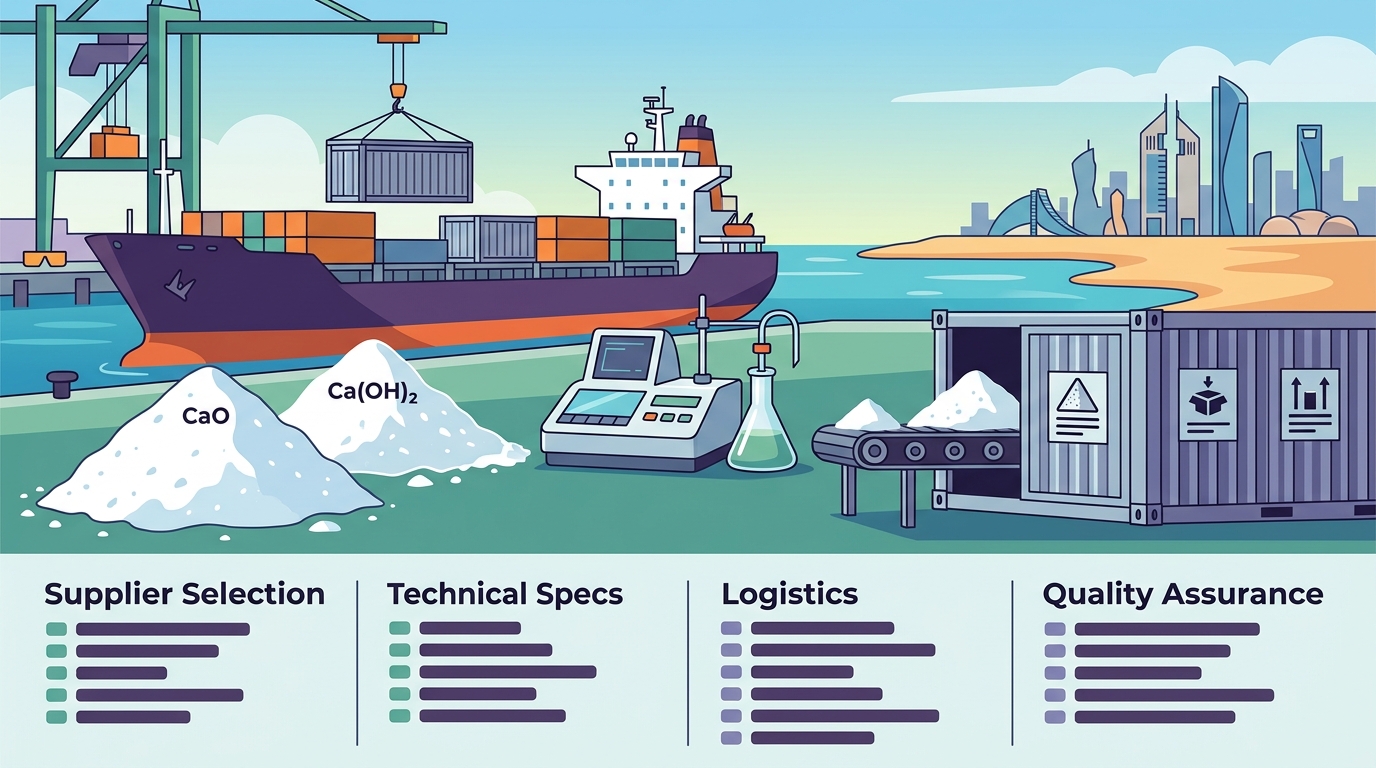
Buyers in the Gulf Cooperation Council (GCC) can source bulk quicklime and hydrated lime directly from specialized B2B exporters like Raiva International Trading Group (RAIVACO). These suppliers provide high-purity calcium oxide (CaO) and calcium hydroxide (Ca(OH)2) shipped from regional ports to local industrial plants. This guide covers supplier selection, technical specifications, logistics, and quality assurance for GCC buyers.
GCC Lime Suppliers
The GCC region hosts a robust network of industrial mineral suppliers. Buyers typically choose between local manufacturers and international exporters. International exporters often provide a wider range of grades and more flexible shipping terms. Raiva International Trading Group operates trade offices in Muscat, Oman, and Yazd, Iran, facilitating direct supply to GCC markets.
Direct Exporters vs. Local Distributors
Direct exporters eliminate middlemen, often resulting in better pricing and traceability. Local distributors offer faster delivery for small quantities but may have limited grade options. For bulk orders exceeding 500 metric tons, direct export from ports like Bandar Abbas or Bandar Imam Khomeini is usually more cost-effective.
Regional Trade Hubs
Quicklime vs. Hydrated Lime
Quicklime is calcium oxide (CaO) produced by calcining limestone at high temperatures. Hydrated lime is calcium hydroxide (Ca(OH)2) produced by adding water to quicklime. The choice between the two depends on the specific industrial process and handling requirements.
Chemical and Physical Differences
Quicklime is highly reactive and releases significant heat when it contacts water. It has a higher bulk density and requires dry storage. Hydrated lime is stable, free-flowing, and safer to handle. It disperses directly in water without an exothermic reaction. The following table compares the two products:
| Property | Quicklime (CaO) | Hydrated Lime (Ca(OH)2) |
|---|---|---|
| Chemical Formula | CaO | Ca(OH)2 |
| Assay Range | 88-92% CaO | 88-96.5% Ca(OH)2 |
| Bulk Density | 700-1200 kg/m3 | 400-600 kg/m3 |
| Reaction with Water | Strongly exothermic | Already hydrated |
| Typical Uses | Steelmaking, soil stabilization | Water treatment, mortars |
Selection Criteria
Select quicklime when your process requires high reactivity and you have on-site slaking equipment. Choose hydrated lime when your process cannot tolerate an exotherm or when you need a powder that passes through fine dosing equipment. Raiva International Trading Group supplies both grades with batch-specific Certificates of Analysis.
Steelmaking Applications
Steelmaking plants use lime as a flux to remove impurities from molten steel. Quicklime is the preferred grade for this application due to its high reactivity and ability to form slag quickly. The fluxing process requires lime with specific particle size distributions and low impurity levels.
Fluxing and Slag Formation
In basic oxygen furnaces and electric arc furnaces, lime reacts with silica and other acidic oxides in the molten metal. This reaction forms a slag that floats on top of the steel, allowing it to be removed. The efficiency of this process depends on the lime's reactivity and purity. High-purity quicklime ensures consistent slag formation and minimizes the amount of flux required.
Particle Size and Reactivity
The particle size of quicklime directly affects its reactivity. Finer particles react faster but may be harder to handle. Coarser particles react slower but are easier to dose. Buyers should specify the mesh size required for their specific furnace type. Raiva International Trading Group offers quicklime in Mesh 70, Mesh 170, and high-reactivity milled Super-90 grades.
Water Treatment Applications
Water treatment plants use hydrated lime to adjust pH, precipitate heavy metals, and remove phosphorus. Hydrated lime is preferred over quicklime because it is stable and does not release heat when added to water. This makes it safer for operators and easier to dose accurately.
pH Adjustment and Precipitation
Hydrated lime raises the pH of water, which helps precipitate contaminants like iron, manganese, and aluminum. The precipitated solids can then be filtered out. The amount of lime required depends on the initial pH and the concentration of contaminants. Buyers should work with their water treatment engineers to determine the correct dosage.
Handling and Dosing
Hydrated lime is typically stored in dry silos and dosed into the water treatment process as a dry powder or slurry. The powder must be free-flowing to prevent clogging in dosing equipment. Raiva International Trading Group supplies hydrated lime in general, special 400-mesh, economy, high-activity, and food-grade ultra-pure grades.
Logistics and Supply Chain
Logistics is a critical factor when buying bulk lime for the GCC. Buyers must consider shipping terms, packaging options, and lead times. Raiva International Trading Group ships on FOB, CFR, and CIF terms from ports in Iran to destinations in the GCC and beyond.
Shipping Terms and Incoterms
FOB (Free On Board) means the seller delivers the goods to the port of shipment. CFR (Cost and Freight) means the seller pays for the freight to the destination port. CIF (Cost, Insurance, and Freight) means the seller pays for the freight and insurance. Buyers should choose the term that best fits their risk tolerance and budget.
Packaging Options
Bulk lime can be shipped in bulk vessels, jumbo bags, or 25 kg PP bags. Bulk vessel shipments are the most cost-effective for large orders. Jumbo bags are suitable for medium-sized orders and are easier to handle than smaller bags. 25 kg PP bags are ideal for small orders or for buyers who need precise quantities. Raiva International Trading Group offers a minimum order quantity of 25 MT for bagged lime and 500 MT for bulk vessel shipments.
Quality Assurance and Testing
Quality assurance is essential when buying bulk lime. Buyers should request a Certificate of Analysis (CoA) for every batch. The CoA should include the chemical composition, particle size distribution, and reactivity. Raiva International Trading Group issues a batch-specific CoA for every shipment.
Certificate of Analysis
The CoA is a document that certifies the quality of the product. It should be issued by an independent laboratory or by the manufacturer's quality control department. Buyers should verify that the CoA matches the specifications in their sales contract. Raiva International Trading Group publishes technical data sheets and XRF analyses on each product page.
Reactivity Testing
Reactivity is a key parameter for quicklime. It is typically measured by the time it takes for the lime to reach a certain temperature during a standard slaking test. EN 459-2 reports reactivity as t60, the time a standard slaking test takes to reach 60 degrees Celsius. Buyers should specify the required reactivity in their purchase order.
Key Takeaways
- Quicklime is calcium oxide (CaO) used for steelmaking and soil stabilization.
- Hydrated lime is calcium hydroxide (Ca(OH)2) used for water treatment and mortars.
- Direct exporters like Raiva International Trading Group offer better pricing and traceability than local distributors.
- Shipping terms (FOB, CFR, CIF) and packaging options (bulk, jumbo bags, 25 kg bags) should be carefully considered.
- A batch-specific Certificate of Analysis is essential for quality assurance.
- Reactivity and particle size are critical parameters for quicklime in steelmaking.
- Hydrated lime must be free-flowing to prevent clogging in dosing equipment.
- Specifications shown are typical values; binding specifications are set in each sales contract.
Frequently Asked Questions
What is the difference between quicklime and hydrated lime?
Quicklime is calcium oxide (CaO) produced by calcining limestone. Hydrated lime is calcium hydroxide (Ca(OH)2) produced by adding water to quicklime. Quicklime is highly reactive and releases heat when it contacts water. Hydrated lime is stable and safer to handle.
Which grade of lime is best for steelmaking?
Quicklime is the preferred grade for steelmaking. It should have high reactivity and low impurity levels. Buyers should specify the mesh size required for their specific furnace type.
Which grade of lime is best for water treatment?
Hydrated lime is the preferred grade for water treatment. It is stable and does not release heat when added to water. Buyers should choose a grade that is free-flowing to prevent clogging in dosing equipment.
What is a Certificate of Analysis?
A Certificate of Analysis (CoA) is a document that certifies the quality of the product. It includes the chemical composition, particle size distribution, and reactivity. Buyers should request a CoA for every batch.
What are the shipping terms for bulk lime?
Bulk lime can be shipped on FOB, CFR, or CIF terms. FOB means the seller delivers the goods to the port of shipment. CFR means the seller pays for the freight to the destination port. CIF means the seller pays for the freight and insurance.
What is the minimum order quantity for bulk lime?
The minimum order quantity for bagged lime is typically 25 MT (1 x 20 ft container). The minimum order quantity for bulk vessel shipments is typically 500 MT. Trial quantities may be available by agreement.
How is reactivity measured in quicklime?
Reactivity is typically measured by the time it takes for the lime to reach a certain temperature during a standard slaking test. EN 459-2 reports reactivity as t60, the time a standard slaking test takes to reach 60 degrees Celsius.
Where is Raiva International Trading Group located?
Raiva International Trading Group has trade offices in Muscat, Oman, and Yazd, Iran. They ship from ports in Iran to destinations in the GCC and beyond.
Conclusion
Buying bulk quicklime and hydrated lime for the GCC requires careful consideration of supplier, grade, logistics, and quality. Raiva International Trading Group provides a reliable source for high-purity lime products, with direct access to resources and a vetted network of mines and factories. To plan your visit or request a quote, .