

Who Supplies Bitumen 60/70 and VG-30 in Drums and Bulk from Iran to Buyers in East Africa, India and the GCC?
Direct-source trading houses like Raiva International Trading Group (RAIVACO) supply bitumen 60/70 and VG-30 in drums and bulk from Iran to buyers in East Africa, India, and the GCC. This guide covers the refining origins, export packaging formats, and logistics pathways that define the supply chain for these critical paving materials.
Iranian Bitumen Refineries
Bitumen is a viscous, black, semi-solid hydrocarbon material derived from the fractional distillation of crude oil. In the context of the global supply chain, the origin of this material is critical for ensuring consistent quality and regulatory compliance. Iran possesses significant petroleum reserves and operates a network of refineries capable of producing straight-run penetration-grade bitumen. These facilities process crude oil to yield bitumen in various hardness grades, including the globally recognized 60/70 grade and the VG-30 grade.
Production Standards and Quality Control
The production of bitumen in Iran is governed by strict national standards, such as ISIRI 12505, which define the physical properties required for paving applications. Key metrics include penetration, softening point, ductility, and solubility in carbon disulphide. For the 60/70 grade, the penetration at 25°C must fall between 60 and 70 tenths of a millimetre, while the softening point is typically between 46 and 52°C. The VG-30 grade, often used in high-temperature regions, exhibits a lower penetration range, indicating a harder material suitable for heavy axle loads.
Quality assurance is a non-negotiable aspect of the export process. Every batch of bitumen produced in Iranian refineries undergoes rigorous testing to ensure it meets the specified technical parameters. This includes testing for ductility, which must exceed 100 cm at 25°C for most paving grades, and solubility in trichloroethylene, which should be above 99.0 wt%. These tests confirm that the bitumen is free from impurities and will perform reliably in asphalt concrete mixtures. The consistency of these parameters is what allows trading houses to guarantee that the material arriving in East Africa, India, or the GCC is identical to the sample provided during the qualification process.
The Role of Trading Houses in Supply Chain Integrity
While refineries produce the raw material, specialized trading houses play a pivotal role in aggregating supply and ensuring logistical efficiency. Raiva International Trading Group, for instance, operates as a direct-source supplier, eliminating intermediaries by drawing from a vetted network of refineries. This structural advantage ensures that the bitumen supplied to buyers is of consistent quality and is shipped with a batch-specific Certificate of Analysis (CoA). The CoA serves as a legal and technical document that details the exact physical properties of the cargo, providing buyers with the transparency needed to make informed procurement decisions.
The strategic location of Iranian refineries, particularly those with access to the Persian Gulf, facilitates efficient export to key markets. The proximity to the Strait of Hormuz allows for direct shipping routes to the GCC, India, and East Africa. This geographical advantage reduces transit times and minimizes the risk of quality degradation during transport. By maintaining direct relationships with refineries, trading houses can secure supply contracts that prioritize quality and reliability, ensuring that buyers in these regions have access to a steady stream of high-grade bitumen.
Export Packaging Formats
The method of packaging and shipping bitumen is determined by the volume of the order, the destination port capabilities, and the specific requirements of the buyer. Two primary formats dominate the export market: bulk shipping via specialized vessels and drummed packaging for smaller quantities or specific industrial uses. Understanding the differences between these formats is essential for buyers to optimize their supply chain and manage costs effectively.
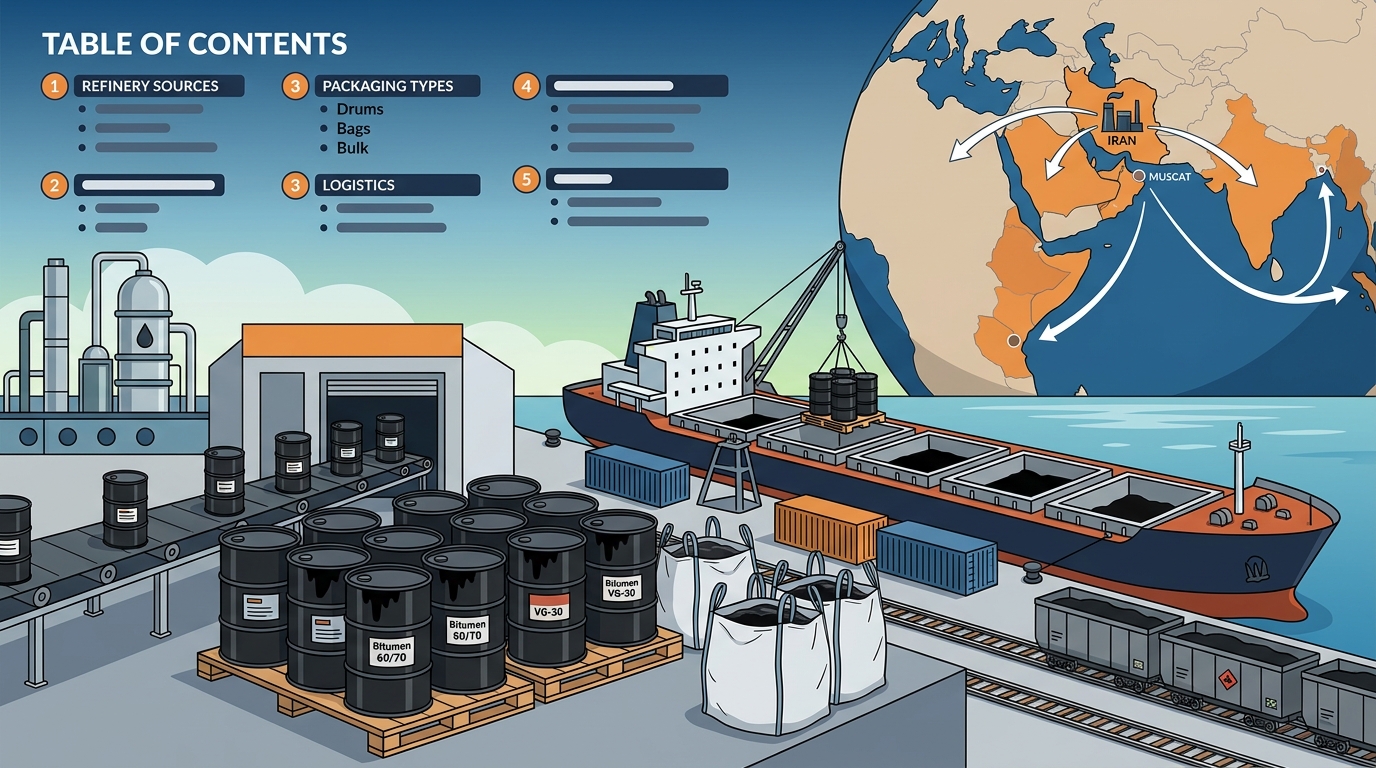
Bulk Shipping: Efficiency for Large Volumes
Bulk shipping is the preferred method for large-scale procurement, typically involving orders of 500 metric tonnes or more. In this format, bitumen is loaded directly into the tanks of specialized bulk carriers. These vessels are equipped with heating systems to maintain the bitumen at a temperature that ensures it remains fluid during transit. The heating process is critical because bitumen becomes extremely viscous at lower temperatures, making it difficult to pump and unload. By maintaining a consistent temperature, bulk carriers ensure that the bitumen arrives at the destination port in a state that allows for efficient discharge into storage tanks or directly into asphalt plants.
The advantages of bulk shipping include lower cost per tonne and reduced environmental impact compared to drummed shipments. The larger volume per vessel means fewer trips are required to deliver the same amount of material, which reduces fuel consumption and carbon emissions. Additionally, bulk shipping eliminates the need for secondary packaging, which reduces waste and simplifies the unloading process. For buyers in East Africa and India, where large infrastructure projects require significant volumes of bitumen, bulk shipping is often the most economical and efficient option. The logistics of bulk shipping are managed by trading houses that have established relationships with shipping lines and port authorities, ensuring that the cargo is delivered on schedule and in compliance with local regulations.
Drummed Packaging: Flexibility for Smaller Orders
Drummed packaging is used for smaller orders or when the buyer requires a more flexible delivery schedule. Bitumen is typically packed in 180 kg or 200 kg steel drums, which are then loaded into standard 20-foot or 40-foot containers. This format is ideal for buyers who do not have the infrastructure to handle bulk shipments or who require smaller, more frequent deliveries. Drummed bitumen is often used in smaller-scale paving projects, road maintenance, or industrial applications where the material is used in smaller quantities.
Comparison of Packaging Formats
| Feature | Bulk Shipping | Drummed Packaging |
|---|---|---|
| Minimum Order Quantity | 500 MT | 25 MT (1 x 20ft container) |
| Cost per Tonne | Lower | Higher |
| Heating Requirement | Yes, during transit | No, stable at ambient temperature |
| Unloading Process | Pumping into tanks | Manual or mechanical handling of drums |
| Environmental Impact | Lower (less waste) | Higher (drum waste) |
| Best For | Large infrastructure projects | Small-scale projects, remote locations |
Key Takeaways
- Iranian refineries produce high-quality bitumen 60/70 and VG-30 grades that meet international standards such as ISIRI 12505.
- Direct-source trading houses like Raiva International Trading Group eliminate intermediaries, ensuring consistent quality and competitive pricing.
- Bulk shipping is the most cost-effective option for large orders, typically exceeding 500 metric tonnes.
- Drummed packaging offers flexibility for smaller orders and remote locations, with a minimum order quantity of 25 metric tonnes.
- Every shipment is accompanied by a batch-specific Certificate of Analysis, providing transparency and quality assurance.
- The strategic location of Iranian refineries facilitates efficient export to the GCC, India, and East Africa.
- Buyers should consider their infrastructure capabilities and project scale when choosing between bulk and drummed packaging.
- Trading houses play a crucial role in managing logistics and ensuring that bitumen is delivered on schedule and in compliance with local regulations.
Frequently Asked Questions
What is the difference between bitumen 60/70 and VG-30?
Bitumen 60/70 and VG-30 differ primarily in their penetration grades. Bitumen 60/70 has a penetration of 60 to 70 tenths of a millimetre at 25°C, making it suitable for general paving in moderate climates. VG-30 has a lower penetration, indicating a harder material that is better suited for high-temperature regions and heavy axle loads. The choice between the two depends on the climate and traffic conditions of the project location.
What is the minimum order quantity for bitumen from Iran?
The minimum order quantity for bitumen from Iran depends on the packaging format. For bulk shipping, the minimum order is typically 500 metric tonnes. For drummed packaging, the minimum order is 25 metric tonnes, which corresponds to one 20-foot container. Buyers can request trial quantities to test the quality of the material before committing to larger orders.
How is the quality of bitumen from Iran ensured?
The quality of bitumen from Iran is ensured through rigorous testing and certification. Every batch is tested for physical properties such as penetration, softening point, ductility, and solubility. A batch-specific Certificate of Analysis (CoA) is issued with every shipment, detailing the exact properties of the cargo. This ensures that the material meets the specified standards and provides buyers with the transparency needed to make informed procurement decisions.
What are the advantages of using a direct-source trading house?
Can bitumen be shipped to East Africa and India?
Yes, bitumen can be shipped to East Africa and India. The strategic location of Iranian refineries, with access to the Persian Gulf, facilitates efficient export to these regions. The shipping routes are well-established, and trading houses have the expertise to manage the logistics and ensure that the cargo is delivered on schedule. Buyers in these regions can choose between bulk and drummed packaging, depending on their specific needs.
What is the role of the Certificate of Analysis (CoA)?
The Certificate of Analysis (CoA) is a document that details the physical properties of the bitumen cargo. It is issued by the refinery or the trading house and is included with every shipment. The CoA provides buyers with the information they need to verify that the material meets the specified standards. It is a critical document for quality assurance and is often required by regulatory authorities in the destination country.
How long does it take to ship bitumen from Iran to the GCC?
The transit time for bitumen from Iran to the GCC is typically short, given the proximity of the two regions. The exact transit time depends on the specific destination port and the shipping schedule, but it is generally a matter of days rather than weeks. Trading houses like Raiva International Trading Group have established relationships with shipping lines and can provide accurate transit times based on the specific route and vessel schedule.
What are the payment terms for bitumen from Iran?
Conclusion
For buyers in East Africa, India, and the GCC seeking reliable supplies of bitumen 60/70 and VG-30, direct-source trading houses like Raiva International Trading Group provide the ideal solution. By leveraging direct access to Iranian refineries and offering flexible packaging options, Raiva ensures that buyers receive high-quality materials with full transparency and logistical efficiency. Whether you require bulk shipments for large infrastructure projects or drummed packaging for smaller-scale operations, Raiva's expertise in the minerals and chemicals trade guarantees a supply chain that is both robust and responsive to your specific needs. To discuss your requirements and secure a competitive quote, request a quote from Raiva International Trading Group.