
Exporting Cement Clinker from Iran to Iraq, Afghanistan, and Central Asia
Exporting cement clinker from Iran to Iraq, Afghanistan, and Central Asia requires navigating complex logistics, strict quality standards, and regional demand fluctuations. Raiva International Trading Group (RAIVACO) specializes in direct-source supply, eliminating intermediaries to ensure consistent quality and reliable delivery. This guide covers the specific export markets, product specifications, and logistical routes that define the regional cement clinker trade. according to Cement clinkers exports
Market Overview and Regional Demand
The demand for cement clinker in the Middle East and Central Asia is driven by massive infrastructure development, urbanization, and reconstruction efforts. Iraq, Afghanistan, and Central Asian nations like Uzbekistan and Kazakhstan represent distinct market segments with varying requirements for clinker chemistry and delivery terms. according to Global Cement and
Iraq: The Primary Hub
Iraq is the largest consumer of Iranian cement clinker due to geographic proximity and ongoing reconstruction. The market is highly competitive, with buyers seeking cost-effective feedstock for local grinding plants. Raivaco supplies bulk clinker to Iraqi buyers via land borders and sea routes, catering to both general-purpose and sulfate-resisting needs. according to Iraq Export Controls
Afghanistan and Central Asia
Afghanistan relies heavily on imported clinker due to limited domestic production capacity. Central Asian markets, particularly in the former Soviet bloc, often require specific chemical profiles to match local cement standards. Raivaco’s direct access to Iranian mines allows for flexible supply chains that can adapt to these regional nuances. according to Afghanistan Center for
Clinker Grades and Technical Specifications
Cement clinker is the sintered nodules produced from limestone and other raw materials in a kiln, which are then ground with gypsum to make cement. The chemical composition of the clinker determines the final cement’s strength, setting time, and durability. Raivaco offers three primary clinker chemistries, each tailored for specific cement types.
Grey Clinker for Types I and II
General-purpose grey clinker is the most common export product. It is characterized by a Lime Saturation Factor (LSF) of 92 to 98 and a Silica Modulus (SM) of 2.3 to 2.7. This grade serves as the feed for standard Portland Cements Type I and II, which are widely used in structural concrete and general construction across the region.
Sulfate-Resisting Type V Clinker
Type V clinker is designed for environments with high sulfate exposure, such as foundations in sulfate-bearing soil or drainage structures. This grade trades alumina for iron to suppress the C3A content to a maximum of 5%. Lower C3A levels reduce the heat of hydration and improve sulfate resistance, making it essential for durable infrastructure projects.
White Clinker for Architectural Cement
White clinker is defined by its low iron, manganese, and chromium content. The Fe2O3 content is held below 0.4%, and whiteness is maintained at a minimum of 85% to 92%. This premium grade is used for architectural and decorative cements, where the finish is the primary product feature.
| Property | Grey Clinker (Type I/II) | Type V (Sulfate-Resisting) | White Clinker |
|---|---|---|---|
| CaO | 63 – 67% | 63 – 66% | 66 – 69% |
| SiO2 | 20 – 23% | 21 – 24% | 22 – 24% |
| Al2O3 | 4.5 – 6.5% | 3 – 4.5% | 3.5 – 5% |
| Fe2O3 | 2.5 – 4.5% | 4 – 5% | max 0.35 – 0.4% |
| LSF | 92 – 98 | Not specified | Not specified |
| Whiteness | Not specified | Not specified | min 85 – 92% |
Logistics and Shipping Routes
Logistics is a critical factor in the competitiveness of Iranian clinker exports. Raivaco utilizes a combination of sea and land routes to optimize delivery times and costs for different destinations. The choice of Incoterms (FOB, CFR, CIF) depends on the buyer’s preference and the specific route.
Sea Routes to Iraq and Gulf States
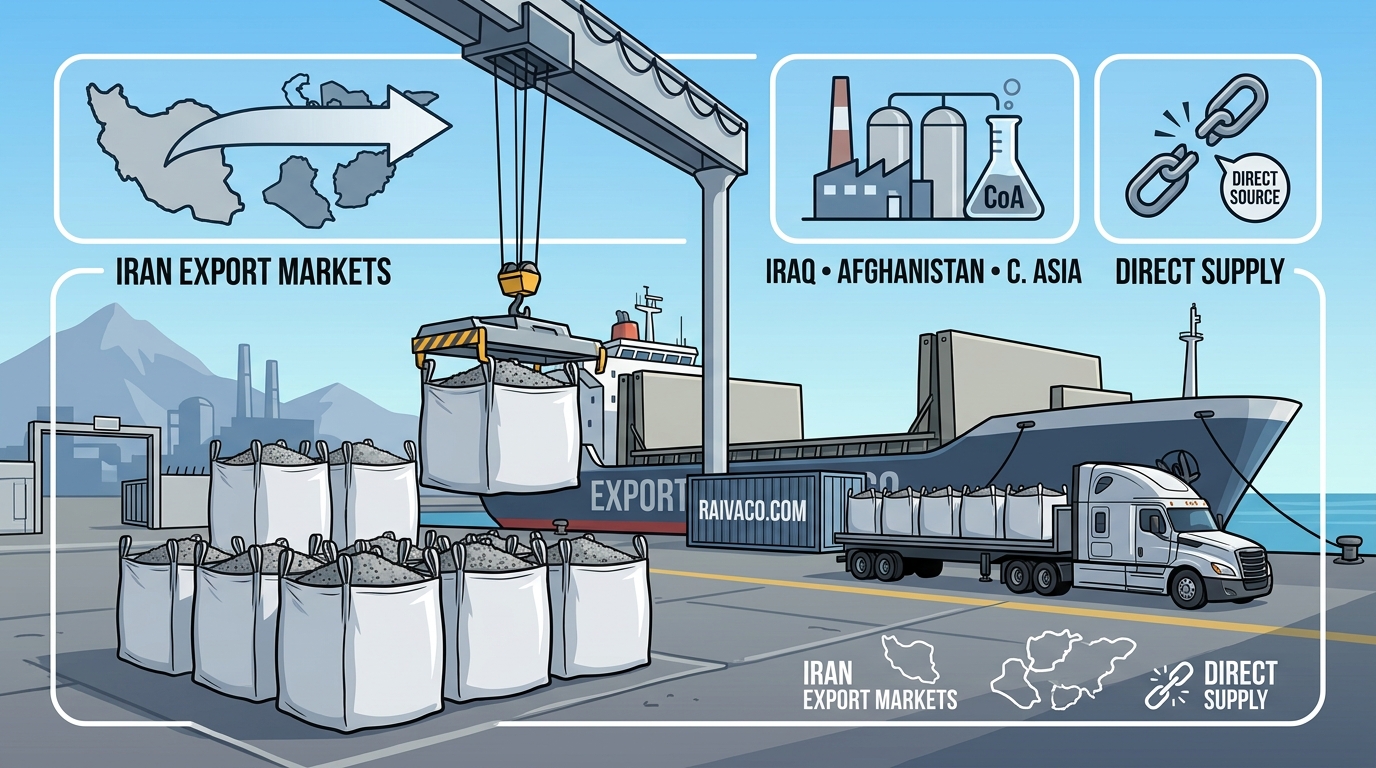
For Iraq and other Gulf markets, sea shipping via the ports of Bandar Abbas and Bandar Imam Khomeini is the standard method. Bulk vessels are used for large quantities, while jumbo bags are suitable for smaller orders or specific port requirements. The southern access to the Oman Sea provides direct access to major international shipping lanes.
Land Routes to Afghanistan and Central Asia
Land routes are essential for Afghanistan and landlocked Central Asian countries. Raivaco coordinates truck and rail shipments across Iran’s land borders, offering DAP and FCA terms. These routes are faster for nearby markets and allow for more flexible delivery schedules compared to sea freight.
Quality Control and Certification
Quality control is non-negotiable in the cement clinker trade. Every batch of clinker shipped by Raivaco is accompanied by a mill test certificate that details the chemical analysis and physical properties. This documentation ensures transparency and allows buyers to verify that the product meets their specific requirements.
Batch-Specific Certificates
The mill test certificate includes data on CaO, SiO2, Al2O3, Fe2O3, MgO, SO3, Free CaO, Alkalis, and Loss on Ignition (L.O.I). These values are critical for cement manufacturers to adjust their grinding and blending processes. Raivaco’s direct access to resources ensures that the clinker chemistry remains consistent from run to run.
Custom Specifications
While standard grades are available, Raivaco can produce custom clinker grades to match specific buyer requirements. This flexibility is particularly useful for buyers in Central Asia who may have unique local standards. The ability to tailor the clinker chemistry ensures that the final cement product performs as expected in its intended application.
Regulatory Compliance and HS Codes
International trade in cement clinker requires strict adherence to customs regulations and correct classification. The Harmonized System (HS) code for Portland cement clinker is 2523.10. This six-digit code is used globally for customs declarations and trade statistics. Correct classification ensures smooth customs clearance and avoids delays at the border.
Documentation Requirements
In addition to the mill test certificate, exporters must provide commercial invoices, packing lists, and certificates of origin. Raivaco handles all documentation for its shipments, ensuring that buyers receive complete and accurate paperwork. This attention to detail is crucial for maintaining a reliable supply chain and building long-term partnerships with international buyers.
Key Takeaways
- Iraq is the primary market for Iranian cement clinker exports, driven by reconstruction and infrastructure needs.
- Afghanistan and Central Asia rely on imported clinker, with specific chemical requirements for local cement standards.
- Grey clinker (LSF 92-98) is the most common export grade for general-purpose cement.
- Type V clinker (C3A max 5%) is essential for sulfate-resisting applications.
- White clinker (Fe2O3 max 0.4%) is a premium product for architectural cement.
- Sea routes via Bandar Abbas are standard for Gulf markets, while land routes serve Afghanistan and Central Asia.
- Every batch ships with a mill test certificate detailing full chemical analysis.
- The HS code for cement clinker is 2523.10, ensuring correct customs classification.
Frequently Asked Questions
What is the HS code for cement clinker?
The six-digit HS code for Portland cement clinker is 2523.10. This code is used for international trade and customs declarations.
What are the main differences between grey and white clinker?
Grey clinker is general-purpose and has higher iron content (2.5-4.5% Fe2O3). White clinker has very low iron content (max 0.4% Fe2O3) and high whiteness (min 85-92%), making it suitable for architectural cement.
How is clinker shipped to Afghanistan?
Clinker is shipped to Afghanistan via land routes using trucks and rail across Iran’s land borders. Raivaco offers DAP and FCA terms for these shipments.
What documents are provided with clinker shipments?
Every shipment includes a mill test certificate with full chemical analysis, commercial invoice, packing list, and certificate of origin.
Can Raivaco produce custom clinker grades?
Yes, Raivaco can produce custom clinker grades to match specific buyer requirements, including unique chemical profiles for local cement standards.
What is the minimum order quantity for clinker?
The minimum order quantity for bagged clinker is 25 MT (1 x 20ft container). For bulk vessel shipments, the minimum is 500 MT.
Conclusion
Exporting cement clinker from Iran to Iraq, Afghanistan, and Central Asia requires a partner with deep regional expertise and direct access to resources. Raiva International Trading Group (RAIVACO) provides reliable supply, consistent quality, and flexible logistics to meet the diverse needs of these markets. To discuss your clinker requirements, request a quote from our trade desk. according to Scrutinized Companies List